Awareness Workshops

Mental health touches every life—across age, culture, and circumstance—yet it is often the part of ourselves we speak about last. The World Health Organization defines health as a state of complete physical, mental and social well-being and not merely the absence of disease or infirmity. Our awareness workshops create a calm, respectful space to learn, ask questions, and take small, practical steps toward that fuller sense of well-being.

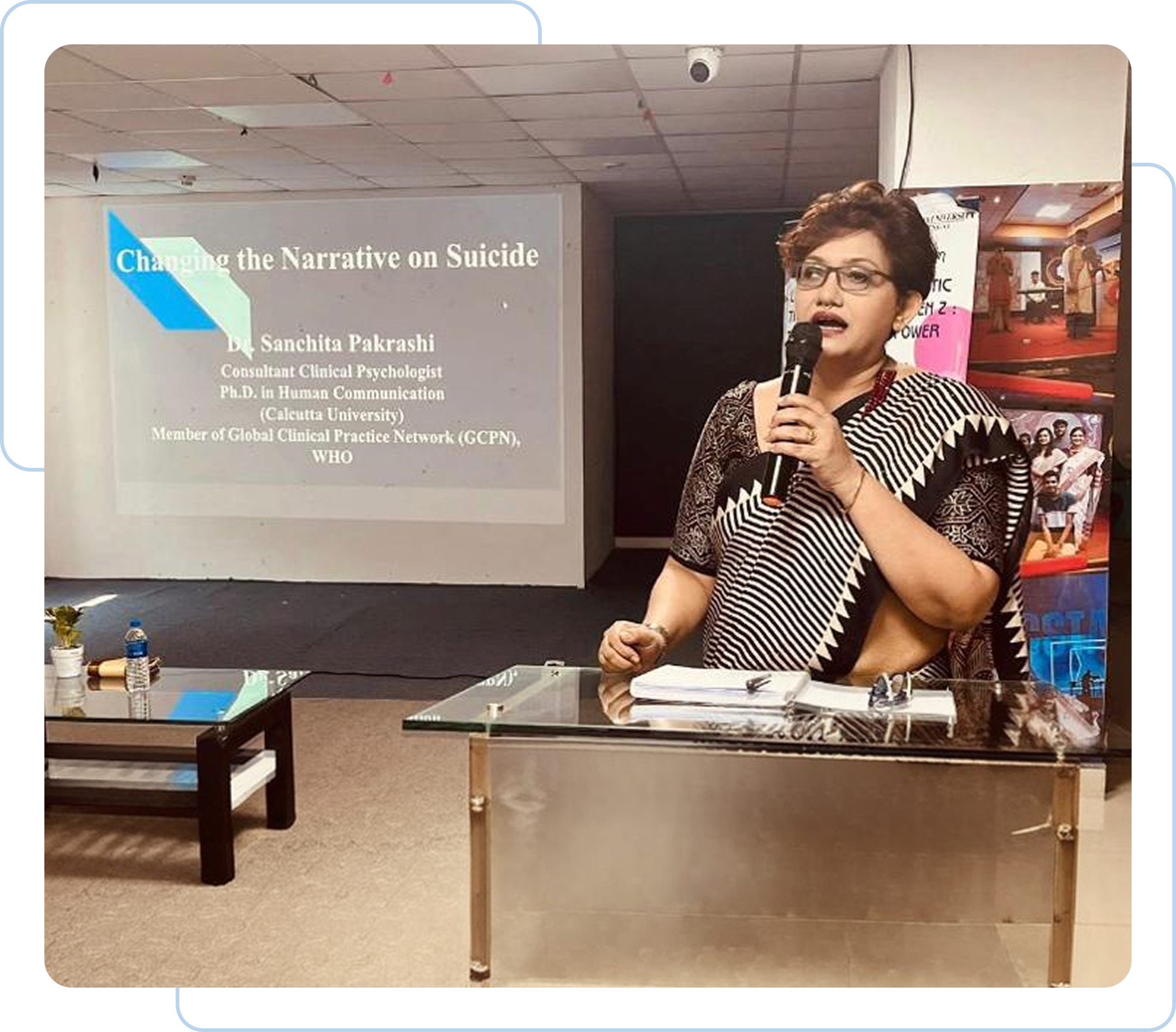
Dr. Sanchita Pakrashi speaking at a podium with a presentation on changing the narrative on suicide.

We live in a strange double standard: a fever, a fracture, or a chronic pain is discussed openly, even with pride in “pushing through”—yet distress of the mind is often met with silence, shame, or discomfort. That reaction rarely reflects education or kindness; it reflects how little safe language we have been given, across every walk of life, for what is happening in our thoughts and feelings.

Two myths do particular harm: that psychological suffering is simply a “weakness” one should “get over” by willpower alone, and that mental health difficulties are inevitably permanent and incurable. Neither is true in most situations people face day to day—yet without calm, factual conversation in families, schools, and workplaces, those myths persist. There remains a serious gap in community awareness, and our workshops begin by naming that gap without judgment, so better questions—and better help—can follow.

Concept Of Mental Health & Hygiene

Health as a holistic approach, a combination of wellbeing of the mind and body are attracting global attention only recently. But it was embedded in ancient Indian culture for years. The natural cure therapies in Atharva Veda provide age-old traditional information to achieve a healthy life balancing mind-body and spiritual well being. The Bhagavadgita considers the inner world or mind as a battlefield for moral struggle to be fought daily and hourly. By taking command of the thought process leaving irrationality behind we can attain wholeness and advance our entity towards attaining greater health for a better society. The great information shared in our culture were forgotten by us and we started living on the instant gratification of our impulses leading to greater sufferings.

The wholeness is never achieved until we are aware of maintaining our healthy psychological aspects. It is an unfortunate fact that we only become aware of mental health issues when we are suffering from one. Just because you are not suffering from any mental aberration does not mean that you can never suffer from one. The concept of good mental health does not mean just the absence of mental disorder.

WHO regards being in good mental health as ‘a state of well-being in which the individual realizes his/her own abilities, can cope with the normal stresses of life, can work productively and fruitfully and is able to make a contribution to his/ her community.’

A good mental health can be attained by maintaining your mental hygiene. The concept of Mental Hygiene deals with ‘the science of maintaining mental health and preventing the development of psychosis, neurosis or other mental disorders.’

Warm, contemplative portrait among flowers—evoking calm, growth, and inner balance.

Our Part In Promoting Mental Health & Hygiene

Our institution has a glorious history of promoting health awareness in the community since 1926. We are currently focusing on organising workshops, campaigns and group therapy sessions in schools, colleges, community centers and corporate houses to promote basic awareness of mental health and hygiene in society.

Our target is to make you aware of the importance of mental health as well as day to day steps to be followed to preserve it through practising good mental hygiene and thus building a healthy society leading to a healthy nation.

Our workshops and campaigns spread awareness regarding mental health issues, the alarming signs and symptoms like Depression, Obsessive Compulsive Disorder (OCD), Anxiety Issues etc. and their possible impacts. We also focus on Management of stress, Addictions (including smartphone addiction), Adjustment Issues (including couple communication problems, parent-child problems in communication etc.), Educational issues in children, Adolescent problems, Parenting Guidance etc. as a part of our awareness campaigns.